
Find Madhwa philosophy slokas, festivals and dasara padagalu


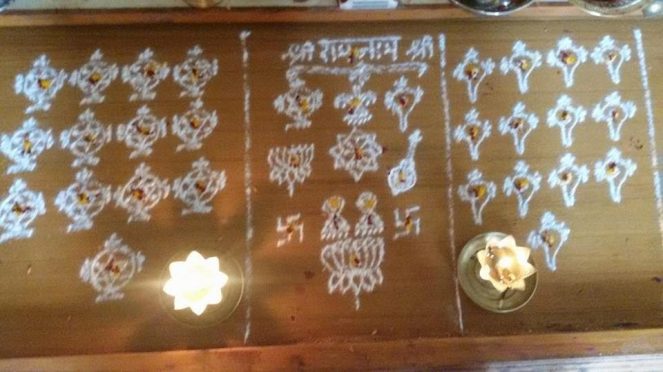
Everyday, Women should clean Threshold(Hosthilu) and should perform pooja. please check the pooja procedure in this link Hosthilu pooja



|
Maasa |
Dhana & Dharma |
| Chaithra maasa |
Udukumba dana Gowri triteeya – morada bhagina to suhasinis Rama Navami & Chithra pournami – panaka, nevermore(butter milk) & kosambari to Brahmana mutthaidaru |
| Vaishaka maasa | panaka, nevermore(butter milk) & kosambari to Brahmana mutthaidharu on all possible days
Askshaya truteeya: Sandals, bisinike(handheld fan), tender coconut water, umbrella, curd rice, sandalwood, cucumber etc Prapadaana(Means making separate area for supplying water, butter milk to the public during hot summer days) Udukumba dana Panaka Pooja and palara pooja |
| Jyeshta | Udukumba dana
Chappals, umbrella, tila, sandalwood, hand fan |
| Aashada | Chappals, umbrella, salt, amla |
| Shravana | Mangala gowi, varalakshmi habba
Sampath shukravara habba – moradha bhagina and udi thumbodhu Naga chathurthi – brahmachari – gopichandana, janivara, vilyadhaladike |
| Bhadrapada | Payasa, Salt & Jaggery
Swana gowri vratha – moradha bhagina to husband’s sister and to one’s own mom or mutthaidharu Rishi Panchami for 7 mutthaidharu, sowmangalya dravya, fruits, chiguli, thembittu should be given |
| Ashwija | Gold, silver(Yatha sakthi)
One pumpkin, Milk, chappals Saaligrama |
| Karthika | Deepa, gopichandana, cow, amla, saaligrama, sankha, vegetables , vana bhojana |
| Margashira | Bindige, Gopichandana |
| Dhanur | Bedsheet, Shayya Dana for Dampatis for Sarvakshema: 2 Carpets, 2 pillows, 2 bedsheets), Huggi dana |
| Pousha | Silver cup, coconut, vasthra dana, tila dana |
| Maagha | Kushmanda, dhathri, Maradha bhagina(Suddha dwadasi), thila dana(Along with a copper cup), salagrama dana, annadhana |
| Phalguna | Sesame seeds, milk, Godhana, vasthra dana |
| Adhika maasa |
Godana, Apoopa dana, Deepa dana, Akhanda Deepa, Daily river bath, Fast on Ekadashi, Dharane,parane, Tamboola dana |
When you should do?
Right from the yugadhi to Vaishaka amavasya, You can do Panaka pooja on any day except on Ekadashis.
You can do panaka pooja on Dashami, Dwadashi, Pournami, Amavasa, or your Janma Nakshatra day are any other suitable days
Mostly I have seen people doing panaka pooja on dwadashi’s. As we consume paarana early in the morning, it would be nice to have panaka pooja in the noon time
when and how you should do?
Mostly this pooja is done around 3.30 to 4.00 pm in the evening. Invite relatives and friends to your home
Prepare dishes like Hunisehannu avalakki, Mosaru avalakki, Rava kesari, sandige, kosambari, panaka, butter milk(neer more), Fruit salads etc
Before serving to guests, do Neivedhya of the prepared dishes and fruits to parmathma and Give thamboola to brahmana , mutthaidharu.
As it is summer months(Chaithra & vaishaka), along with Panaka pooja vilyadhaladike, You can also plan to give dana items like Umbrella, Chappals, Udakumbha dhana etc
Uda-kumbha means giving drinking water with the pot(Copper/Brass)
This is a visesha dhana usually given during Summer months(Chaithra maasa and Vaishaka maasa)
Chant this mantra and give dhana
Esha dharmaghato data brahma Vishnu shivathmakah
Asyapradhana thrupthyanthu pitharassa pithamaha
This posts is completely for beginners.
How to serve habba adige?
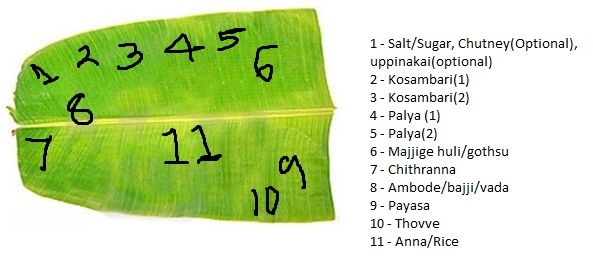
There should not be any panthi beda(difference in serving). like for our dear ones serving more ghee , sweets, ambode than others is not a good way of serving the meal
ಬೀಗರೂಟಕೆ ಅನೇಕ ಭೋಗವು
ಜೋಳವು ಓಗರ ಬ್ರಾಹ್ಮಣರೆಡೆಯೊಳು
ಘಮ್ಮನೆ ತುಪ್ಪವು ತಮ್ಮನೆಯವರಿಗೆ
ಘಮ್ಮಟು ದೇವ ಬ್ರಾಹ್ಮಣರಿಗೆbIgarUTake anEka BOgavu
jOLavu Ogara brAhmaNareDeyoLu
Gammane tuppavu tammaneyavarige
GammaTu dEva brAhmaNarige— Pranesha dasaru
Usually for habba, we dont prepare items using Rava(Rava kesari, Rava payasa etc) and we should not do Urad dal vada.
We dont prepare regular sambhar on festival days, We should do kootu, bisibela bath, majjige huli etc
Do Hari sankirthana in between the meal(usually we hear it in mutt at the end of dasara pada as “Bhojane kale sankirthana sri _____(deity name) jai jai”)
Generally till the men finishes their food, and wash their hands, Make sure all the others including kids are seated.
Usually at the end of the meal, we will generally put water over the unused salt and dissolve it(Marks the end of the meal)
As everyone know, when we eat habba adige(With sweets and payasa), we should not remove the leafs/plate immediately after finishing meal. We have to wash our hands and then only rest of the cleaning has to be done
|
Sno |
Dish |
Varieties |
| 1. | Chutney | Kadle bele chutney |
| Kayi chutney | ||
| Uppinakayi | Mavinakayi uppinakayi | |
| Limbehannu uppinakayi | ||
| 2. | Kosambari 1 & 2 | Kadalebele kosambari |
| Moong dal kosambari | ||
| Hesarukalu/Green gram kosambari | ||
| 3. | Palya 1 & 2 | Bendekayi palya |
| Yellow pumpkin Palya | ||
| Suran palya | ||
| Balekayi palya | ||
| Beans palya | ||
| Southekayi palya(Cucumber) | ||
| 4. | Majjige huli | Bhendekayi majjige huli |
| Hasi majjige huli | ||
| White pumpkin majjige huli | ||
| Gojju | Pineapple gojju | |
| Bendekayi gojju | ||
| Mavinakayi gojju | ||
| 5. | Chithranna | Limbekayi Chithranna |
| Mavinekayi Chithranna | ||
| Puliyogare | ||
| Kayi sasive chithranna | ||
| 6. | Fried items | Ambode |
| Bajji | ||
| Bonda | ||
| Appala | ||
| 7. | Payasa | Appi payasa |
| Rice kheer | ||
| Avalakki payasa | ||
| Akki kadelebele payasa | ||
| Sabbaki payasa | ||
| Shavige payasa | ||
| 8. | Thovve | Toor dal tovve |
| 9. | Main course | Rice |
| Kootu | ||
| Bisibela bath | ||
| Saaru | ||
| Mosaru | ||
| 10. | Sweet | Mysore pak |
| Hayagreeva mudde | ||
| Holige | ||
| Karida kadubu |
I wish to write a post on Marathi deshasthas for a long time. When someone sees us in Mutt/Temple speaking Marathi, The immediate question they ask with raised eye brows “Oh! neevu deshasthara?” And in Common weddings/Functions, Majority of Kannada people will start trolling Desasthas(As we are in minimum numbers). Though its funny most of the times, It is not sometimes. Few people pass comment on us as “Kayre kottre janagalu” (Sometimes I feel like, am i looking like an Alien or what? 😉 😉 )
And Those who did studies in Tamilnadu, Would have faced even more such situations from friend’s circle. “Oh you look Tamilian and You speak very good Tamil, How come you speak Marathi @ home and how you can be a Maharashtrian?” .
And those who have lived near Mumbai area, will start interviewing you in Marathi( who claim it as purest)as if you are submitting your PhD thesis.
I have answered many people around me @ Every stage of life,” I am Marathi desashtha, My roots are from Thanjore. Somehow migrated across south India for work long back (Three to four generations atleast) ” . In recent years I came to know the exact history of who we are?
Disclaimer: And the above statements are out and out my personal experience and I am not talking about everyone 🙂
When i was studying Middle school, we went on a family Yatra to Kolhapur Mahalakshmi Mandir(Our family deity) and pandrapur vittobha by Road Travelling through Karnataka(We Visited so many moola brindavanas). I was in the mindset as We know Marathi, We are going to easily manage our stay in Maharashtra. But it is not. Though we can understand the language, It was so hard to reply in a perfect sentence. Whatever we speak is a mix of Marathi + Tamil(And in these recent years,influence of English + Kannada also)
Yes We exists! We are Marathi speaking Madhwa Deshasthas. We are Dvaitha followers. Just because we speak a different language doesn’t mean we are different. We follow all the rituals and procedures and Philosophy of our Great Madhwa Doctrine
Who are We?
Ekoji-I or Venkoji was the younger half-brother of Shivaji and founder of Maratha rule in Thanjavur. The Marathi inscriptions of the Thanjavur temple dates the capture of Thanjavur to January 1676
WHEN the Mahrattas ruled Tamil Nadu from Thanjavur (their dynasty was founded by Chatrapati Shivaji’s half-brother Venkoji) for nearly two centuries from 1675, they encouraged a large number of settlers from the Deccan and Karnataka to consolidate their power in the South. Many Brahmins and Kshatriyas, known as Deshasthas, found their homes in the fertile Cauvery delta, Thanjavur and its neighbourhood.
The Hindu, Jan 15, 2000
A larger part of the migration of these people from their homeland to Tamil Nadu took place between 1712 and 1726, when Serfoji I invited the brahmins from his homeland and offered them vast lands. Records showed that the migrations ceased after 1855, says Yeshwanth Rao, a member of the Mahratta Education Fund (MEF), an organisation of this community.
The Times of India, Aug 7, 2012
Look at the origin of Sambhar:
One of the stories is that it originated in the kitchen of Thanjavur Marathas ruler Shahuji during the 17th century from the southern Indian state of Tamil Nadu.[1] Shahuji trying to make a dish called amti, experimented with pigeon peas instead of mung bean, and tamarind pulp for kokum and the court named it sambhar after the guest of the day, Sambhaji, second emperor of the Maratha Empire
Wikipedia
(Proud inventor of Sambhar)
I have seen most of the Marathi speaking Madhwa, easily learns and adapts kannada language. Why not the same in reverse?
I am going to post few of the commonly used words and sentences in Marathi. Those who want to learn Marathi, Can start learning and impress your near and dear ones!!!
Let us learn Marathi
|
Phrase |
Marathi word |
| How are you | Kasa ayenta |
| I am fine | Me besha ayen |
| What is your name(Addressing to elder one/with respect) | Tumcha nama kaaya? |
| What is your name(Addressing to younger one/without respect) | Tuja naama kaaya? |
| My name is ____________ | Maja naama _______ |
| Hello/Greetings | Namaskara |
| How much does it costs? | Kavda mola? |
| Where are you going? | Kotta jathaayintha? |
| When will you come? | Kamma yeyala? |
| What do you want? | Tumaal kaaya payye? |
| Had your food? | Jevna jaalaka? |
| Do you want water? | Paani payekka? |
| Are you feeling sleepy? | Jomba ethaka? |
| What is the time now? | Attha kaaya gante? |
| Are you feeling hungry? | Bhook lagatha ka? |
| Do you need anything? | Kaithri payyeka? |
| Where are you now? | Kotta ayentha? |
| See you tomorrow | Uja pamna |
| Shall we talk now? | Attha boluvyaka? |
| Take care | Anga paanga |
| Question |
Marathi word |
| What | Kaaya |
| How | Kasa |
| When | Kamma |
| Why | Kajala |
| Where | Kotta |
| Which | Kotta |
| Who | kona |
|
Grocery |
Marathi word |
| Rice | Tandool |
| Urad dhal | Udidacha dala |
| Moong dal/Green gram | Mooga dal |
| Split chick pea/Chana dhal | Chanach dal |
| Wheat | Gahoon |
| Sugar | Saakara |
| Wheat flour | Gavacha peeta |
| Salt | Meeta |
| Mustard seeds | Mohra |
| Tamarind | Chincha |
| Red chilles | Thamda mirsinga |
| Coriander seeds | Dhane |
| Fenugreek seeds | Methi |
| Cumin seeds | Jire |
| Pepper | Mire |
| Sesame seeds | Til |
| Jaggery | Gul |
| Peanuts | Shengdana |
| Milk | Dhoodh |
| Yogurt/curd | Daahin |
| Ghee | Thoopa |
| Sesame oil | Chakot thela |
| Butter | Loni |
| Cashew nuts | Bibba |
| Raisins | Dhrakshe |
|
Vegetable |
Marathi word |
| Lime | Limbu |
| Ginger | Aala |
| Brinjal | Vangi |
| Pumpkin | Bhomba |
| Yam | Suran |
| Greens/spinach | Paala |
| Chillies | Mirsinga |
| Coconut | Narla |
| Cluster beans | Senga |
|
Emotion/character |
Marathi word |
| Anger | Raaga |
| Happy | Santhosha |
| Sad | Vesan |
| Love | Laad |
| Suspicious/doubtful | Sandega |
| Fear | Beh |
| One who fears | Bhikondi |
| Pride | Garva |
| One who shows off | Jhambista |
| Show off | Jhamba |
| One who is so proud of himself/herself | Garvishta |
| Rough person | Moratt |
| Dignified | Gambhira |
|
Dish |
Marathi |
| Curry | Bhaaji |
| Rasam/saaru | Saara |
| Dhal | Varna |
| Sambhar/Huli | Sambhar |
| Kootu | Pitla |
| See kootu | Sapak pitla |
| Payasa | Kheer |
| Dhal vada | Ambode |
| Majjige huli | Kadi |
| Bisibela bath | Mandi sambar bath |
| Curd | Dahi |
| Lemon rice | Limbacha bath |
| Rice | Batha |
| Mixed rice | Kalivaltha batha |
|
Taste |
Marathi word |
| Sour | Ambatta |
| Sweet | Gulchitta |
| Spicy | Thikkatta |
| Bitter | Kadu |
| Bland | sapak |
|
Color |
Marathi word |
| Red | Thambda |
| Black | Kaala |
| White | Pandra |
| Green | Hirva |
| Blue | Neela |
| Yellow | Piyula |
| Oranga | Naarangi |
|
Relationship |
Marathi word |
| Father | Bapa |
| Mother | Amma |
| Brother | Bhau |
| Sister | Bhahin |
| Father’s brother | Kakka |
| Paternal uncle’s wife | Kakki |
| Grandfather | Aaja |
| Grand mother | aaji |
| Mother’s sister | Mausi |
| Father’s sister | Athya |
| Mother’s brother | Mama |
| Maternal uncle’s wife | Maami |
| Sister in law | Vaini/Vahini |
| Brother in law | Bavoji |
| Wife’s brother | Mevana |
| Wife’s sister | Mevini |
| Father in law | Sasra |
| Mother in law | Saasu |
| Husband’s brother | Dera |
| Husband’s elder sister | Vainaka |
| Husband’s Younger sister | Nananda |
| Brother’s wife | Bauja |
| Son in law/ Daughter in law father | Vyaahin |
| Son in law/ Daughter in law mother | Vihina |
| Cousin brother(Maternal aunt son) | Maausa baavu |
| Cousin sister(Maternal aunt daughter) | Maausa bahina |
|
Body parts |
Marathi word |
| Head | Doska |
| Ear | Kaan |
| Eyes | Dola |
| Face | Thonda |
| Tooth | Dhanta |
| Neck | Gala |
| Chest | Oora |
| Hand | Hatha |
| Leg | Paaya |
| Stomach | Pota |
| Back | Mada |
| Fingers | Bota |
|
Day |
Marathi word |
| Monday | SOMVAAR |
| Tuesday | Mangalvaar |
| Wednesday | Budhavaar |
| Thursday | Guruvaar |
| Friday | Shukravaar |
| Saturday | Shanivaar |
| Sunday | Aithvar |
|
Miscellaenous Words |
Marathi word |
| Not doing well | Aang bharni |
| Cold | Padasa |
| Cough | Konkla |
| Throat pain | Ghasa dhukta |
| Body pain | Aang soola |
| Fever | Jara |
| Broke | Modla(Hath modla – broken hand, PAaya modla – Broken leg) |
| Cut | Chiru |
| Pus | Poon |
| Tumors | Gadda |
| Lamp | Diva |
| Festival | Sena |
| Bowl | Vaati |
| Ring the bell | Ghanta vajiva |
| Conch | Shanka |
| Plate | Thaata |
| Vessel | Pathra |
| Brass vessel | Kancha |
| Frying pan | Thel thava |
| Huge vessel for storing water | Gangaala |
| Kudam/vessel for carrying water | Ghagara |
| Serving spoon | Phali |
| Flat spoon for making chapathi/dosa | Ucchatni |
| Slotted spoon for frying | Jharni |
| Vessel to hold water during meal | Thambe |
| Thread | Dhora |
| Silk | Reshme |
| Veranda | Naduvi |
| Nine yard saree | Nau gacha lugda |
| Women in periods | Vittaalsi |
| Stove | Choola |
| Flower | Phula |
| Fruits | Pandu |
| Tree | Jhaada |
| Bush | Judupa |
| Stitch | Seevna |
| Comb | Pani |
| Combing | Vinchara |
| Left hand | Dava haatha |
| Right hand | Ujva haatha |
| DosA | Dhirda |
| Winter | Himaala |
| Summer | Unaala |
| Rain | Pausa |
| Windy | Vaaravasi |
| Teacher | Panthoji |
| Bag | Pisivi |
| Kitchen | Sampak koli |
| Room | Koli |
| Bedsheet cover/comforter | Pangurna |
| Free time | Rikaama |
| Maths | Ishoba |
| Bedding | Anthurna |
| Cot | Palanga |
| Bad guy | Vangla |
| Bad women | Vangli |
| Hot water | Unu paani |
| Cold water | Himsa paani |
| Feeling cold | Hima vastha |
|
Number |
Marathi word |
| 1 | Ek |
| 2 | Dona |
| 3 | Theena |
| 4 | Chaara |
| 5 | Paancha |
| 6 | Saha |
| 7 | Saatha |
| 8 | Aata |
| 9 | Nou |
| 10 | Daha |
| 11 | Akra |
| 12 | Bhara |
| 13 | Thera |
| 14 | Chouda |
| 15 | Pandhra |
| 16 | Soula |
| 17 | Sathra |
| 18 | Athra |
| 19 | Ekunavees |
| 20 | Vees |
| 21 | Ekevees |
| 22 | Baavees |
| 23 | Theevees |
| 24 | Chouvees |
| 25 | Panchivees |
| 26 | Souvees |
| 27 | Sattavees |
| 28 | Attavees |
| 29 | Ekunathees |
| 30 | These |
|
40 |
Chalees |
| 50 | Pannas |
| 60 | Saati |
| 70 | Sattar |
I remember few of the rhymes in Marathi My grandfather used to tell us:
Jhoola hatthi jhoola re
hathi soonda phoola re
devakicha moola re
hathi kasha jhoolatha
raama kasha bolotho
Kasha hasto ha!ha!ha!
Motha paan maanduna
koshambari ghaluna
bhaji ghaluna
bhaat galuna ( while holding your palm up as a plate and holding baby’s hand to mash the imaginary cooked rice).
Thoop galuna
daal galuna
besh kalivuna
paal karuna
thejantha kadi galuna
kadi paal phutla, phutla, phutla (tickling hand)
 Madhwa